Table of Contents
Interior Painting vs Cabinet Painting: What Is the Difference?
Interior painting and cabinet painting are both indoor paint services, but they are not the same kind of project. They use different prep steps, different finish systems, and different durability expectations.
That matters because walls, ceilings, and trim are broad decorative surfaces. Cabinets are detailed, high-touch surfaces that are opened, closed, handled, and viewed up close every day. A cabinet finish has to perform differently from a wall finish.
For homeowners comparing options, the better question is not only what needs to be painted. The better question is: what kind of surface is being painted, and what finish that surface actually needs.
Quick Comparison: Interior Painting vs Cabinet Painting
A simple way to separate them is this:
- interior painting is for surfaces like walls, ceilings, trim, and general room updates
- cabinet painting is for cabinets, vanities, and built-in storage that need a smoother, more durable finish
That difference matters because the prep and finish goals are not the same.
If you need a broad overview of the services first, start with the main Kernersville painting company page.
Why Cabinet Painting Is a More Specialized Process
That’s the biggest difference in the SERP and in real projects.
Cabinet painting is a more specialized process because cabinets are handled up close and used every day. They are opened, closed, touched by hands, exposed to grease and residue, and judged more closely than a normal painted wall.
That means cabinet work usually demands:
- more exact surface prep
- more attention to adhesion
- more finish control
- stronger product choices
- better durability under daily use
A wall repaint is still important, but it is not usually held to the same close-range finish standard as a cabinet.
Interior Painting Is Built Around Rooms and General Living Surfaces
Interior painting usually focuses on the larger painted surfaces inside the home.
That may include:
- walls
- ceilings
- trim
- doors
- hallways
- bedrooms
- living spaces
- common interior areas
The goal is usually to refresh the color, improve the room’s look, and create a clean, even finish across the visible space.
For this type of project, review interior painting services.
Cabinet Painting Is Built Around Detailed, High-Touch Surfaces
Cabinet painting is different because cabinets are treated more like finish surfaces than broad room surfaces.
That may include:
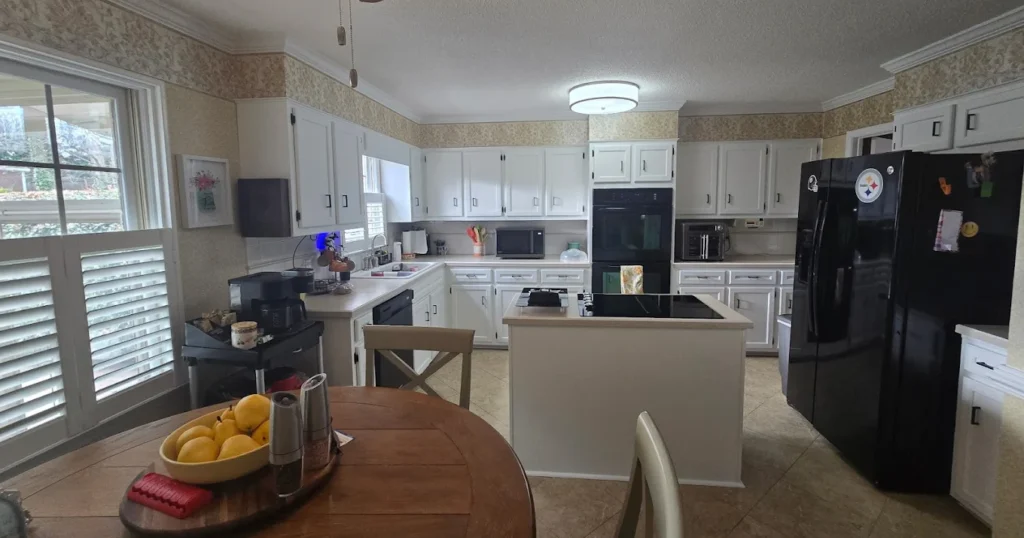
- kitchen cabinets
- bathroom vanities
- built-in storage
- laundry cabinets
- cabinet doors
- cabinet drawers
- face frames and other cabinet details
These surfaces need more control because they are:
- touched often
- viewed at close range
- more likely to show unevenness
- expected to hold up under regular use
For this type of project, review cabinet painting.
Cabinet Prep Usually Includes More Than Wall Prep
That’s where many homeowners underestimate the difference.
A wall may need patching, spot sanding, and normal prep before painting.
Cabinets often require a more detailed process because the surfaces are different and the finish standard is higher.
Cabinet painting prep may include:
- heavier cleaning and degreasing
- more detailed sanding
- closer control of surface smoothness
- stronger attention to adhesion
- targeted primer
- working around or removing hardware
- more careful treatment of cabinet doors and drawers
That is why homeowners should not assume that wall-paint prep and cabinet-paint prep are interchangeable.
Walls and Cabinets Do Not Wear the Same Way
A wall and a cabinet may both be painted, but they are used differently.
A wall mostly needs visual coverage and a clean, finished surface. A cabinet needs a finish that can withstand repeated touching, opening and closing, wiping, and close-range viewing.
That is why cabinet painting vs wall painting should not be treated as the same job.
The surface use is different.
The wear level is different.
The finish expectation is different.
Cabinets Need a Smoother, More Durable Finish Than Walls
That is another major difference.
Interior painting is often judged across broad surfaces. Cabinet painting is judged at close range. That means a cabinet finish usually needs more exact control around:
- smoothness
- edge detail
- coverage consistency
- touch durability
- finish feel
- how clean the surface looks under normal lighting
That’s why cabinet painting often aims for a more factory-like finish than a standard wall repaint.
Cabinet Painting Often Uses a Different Finish System
Many homeowners think the difference is only about color.
It is not.
Cabinets often need a finish system built around stronger surface performance.
That can include high-performance coatings chosen for better durability and daily-use resistance. Walls usually do not need the same level of finish system because they are not handled in the same way.
That is why the real question is not only, “What color do you want?”
The better question is, “What finish system does this surface need?”
Can You Use Normal Wall Paint on Cabinets?
That is one of the most common homeowner questions.
In practice, cabinets should not be treated like standard wall surfaces. Cabinet painting usually needs a more specialized prep and finish approach than normal interior wall paint logic.
That is because cabinets need:
- better adhesion
- smoother finish control
- stronger daily-use durability
- better resistance to repeated touching and cleaning
So even when both services involve paint, the process and finish expectations are not the same.
Cabinet Painting Also Has a Different Curing Expectation
A cabinet may look dry before it is fully ready for daily use.
That is why curing time matters more with cabinets than with many wall surfaces. Cabinets are touched with hands, opened and closed, and returned to normal use quickly if the homeowner is not properly warned.
A surface that appears dry may not be fully cured. That is one reason cabinet painting should be considered a more specialized service, not just a smaller wall-painting project.
When Interior Painting Makes More Sense
Interior painting usually makes more sense when:
- the goal is to repaint one or more rooms
- walls or ceilings need a color update
- trim and doors need a coordinated interior refresh
- the project is about the room as a whole
- cabinet surfaces are not the main focus
That’s the better fit for broader room-focused work.
When Cabinet Painting Makes More Sense
Cabinet painting usually makes more sense when:
- the cabinets are the main focus
- the project is in a kitchen, bath, laundry, or built-in storage area
- the finish needs to look smooth up close
- the homeowner wants to update cabinets without replacing them
- the surface needs a more detailed finish plan than a normal wall repaint
That is the better fit when the cabinet finish itself is the real project.
Some Projects Need Both Services
Sometimes the right answer is not one or the other. It is both.
Examples include:
- a kitchen where the walls are being repainted, and the cabinets are being updated, too
- a bathroom where the vanity and the room color are both changing
- a laundry room with cabinets plus general interior surfaces
- a built-in storage area inside a larger room, repaint
In those cases, the project still needs the surfaces separated correctly. The room painting and the cabinet finishing should be scoped as different finishes, even if they happen together.
Surface Prep Still Connects These Two Services
Even though the services are different, both still depend on good surface prep.
That may include:
- patching and smoothing for walls
- proper cleaning
- sanding where needed
- using primer where needed
- making sure the surface is truly paint-ready
If the room has damaged walls before painting starts, that may also overlap with drywall repair before finish work begins.
What Homeowners Should Look for in an Estimate
A strong estimate should make the service type clear.
It should help you understand:
- whether the project is room-focused or cabinet-focused
- what surfaces are included
- what prep is included
- whether cabinet prep is separated from wall prep
- whether degreasing, sanding, or hardware handling are part of cabinet prep
- whether the finish expectation is broad room coverage or detailed cabinet finish work
- whether both services are part of the same project
If those points are vague, homeowners may think they are comparing the same kind of job when they are not.
Red Flags When Cabinet Painting and Interior Painting Are Blended Too Broadly
Some quotes refer to “interior painting” without clearly distinguishing cabinet work.
That can be a problem.
Common red flags include:
- treating cabinets like standard wall surfaces
- no clear difference between room prep and cabinet prep
- no mention of degreasing
- no mention of sanding
- no mention of adhesion
- no explanation of finish durability
- no separation between the room scope and the cabinet scope
These usually mean the job is not being explained clearly enough.
Which Service Should You Start With?
If the project is primarily about rooms, walls, ceilings, and trim, start with interior painting.
If the project is mainly about kitchen cabinets, vanities, or built-in storage, start with cabinet painting.
If the space includes both types of surfaces, the estimate should clearly separate them rather than lumping them into a single vague line item.
Final Thoughts
Interior painting vs cabinet painting is really a question about the surface, the finish goal, and the level of detail the project needs.
A room repaint focuses on walls, ceilings, trim, and the overall appearance of the space. Cabinet painting is built around detailed, high-touch surfaces that need more exact prep, stronger finish logic, and a smoother, more durable result.
For homeowners comparing options, Johnson Painting Co. & More should be judged the same way: by how clearly the service is separated, how well the prep matches the surface, and whether the finish plan fits the real project.
FAQs
Yes. Cabinet painting usually needs a more specialized prep and finish system than standard interior painting because cabinets are high-touch surfaces.
Cabinets should not be treated like standard wall surfaces. They usually need a more specialized process focused on adhesion, finish smoothness, and daily-use durability.
Cabinet painting often takes more prep, including degreasing, sanding, handling doors, drawers, and hardware, plus tighter finish control.
In many cases, yes. Cabinets often need more detailed prep than walls because residue, oils, and finish condition affect how well the new coating bonds.
Cabinets are detailed, high-touch surfaces that require stronger prep, tighter finish control, and greater durability than broad wall surfaces.
Request an Estimate for Your Project
If you are comparing indoor paint projects, do not start with color alone. Start with the surface, how it is used, and what kind of finish the project really needs.
Then review the main Kernersville painting company page, choose the service that fits the space, and request an estimate when you are ready to move forward.